Understanding the 4 Most Common Faucet Types for Your Home
Identifying the right faucet types is an essential part of any plumbing fixture installation project. Whether you are rinsing dishes, filling pots, or simply washing your hands, the internal valve mechanism of your fixture determines its performance and lifespan. At Lifetime Plumbing, we have found that choosing between different faucet types can be overwhelming, but making the right choice now will save you from frequent leaks and costly repairs in the future.
In this comprehensive guide, we will break down the mechanics, pros, and cons of the four primary faucet types used in modern kitchens and bathrooms. By the end of this article, you will be able to identify which model fits your sink configuration and your budget.
Quick Comparison of Faucet Valve Technologies
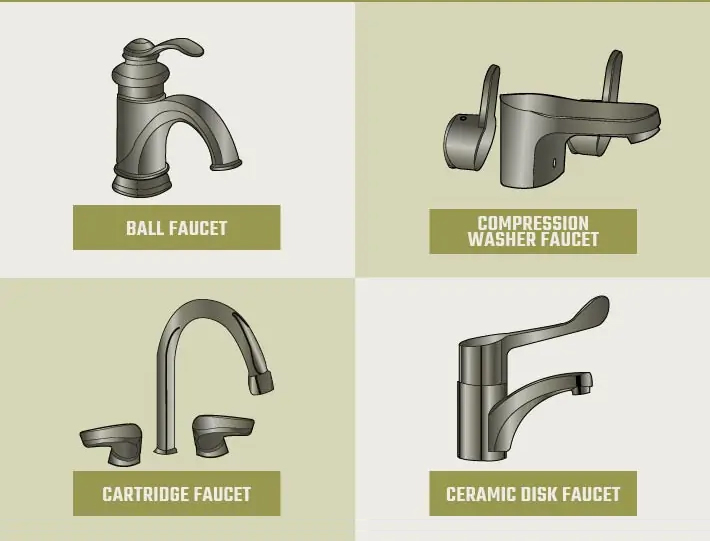
| Faucet Type | Valve Mechanism | Durability | Common Issue |
|---|---|---|---|
| Ball | Rotating Metal Ball | High | O-ring wear |
| Disk | Ceramic Disks | Highest | Sediment buildup |
| Cartridge | Plastic/Brass Sleeve | High | Cartridge clogging |
| Compression | Rubber Washer | Low | Dripping handles |
1. Ball Faucet Types (Single-Handle Washerless)
Overview of Ball Faucets
Ball faucets are one of the most common faucet types found in kitchens across the country. They were the first type of washerless faucet on the market and are easily recognizable by their single handle that moves over a rounded, ball-shaped cap. This design allows you to control both water flow and temperature with one seamless motion.
How Ball Faucets Work
The mechanism inside uses a slotted metal or plastic ball. As you move the handle, the ball rotates against rubber O-rings and spring-loaded seals to align with hot and cold water inlets. Many modern WaterSense certified faucets utilize this single-lever technology to help homeowners reduce water waste.
- Pros: Affordable, easy to operate, and widely available in various finishes.
- Cons: Because they have more internal moving parts (springs, seals, and the ball itself), they are more prone to leaks than modern disk faucets.
2. Disc Faucet Types (Modern Ceramic Technology)
If you are looking for the highest quality among all faucet types, the ceramic disc faucet is the answer. These are the latest advancement in faucet technology, designed to be nearly maintenance-free.
The Ceramic Advantage
Inside a disc faucet, there are two ceramic disks: one remains stationary while the other rotates or slides over it. These disks are diamond-hard and create a watertight seal that is incredibly resistant to wear. Unlike rubber washers, ceramic does not rot or lose its shape over time.
- Pros: Extremely durable, rarely leaks, and provides very precise control over water temperature.
- Cons: Generally more expensive upfront, and if the disks do crack (usually due to extreme sediment), the entire assembly must be replaced.
3. Cartridge Faucet Types (Double or Single Handle)
Cartridge faucet types are known for their incredibly smooth action. They come in both single-handle and double-handle versions. Unlike a ball faucet that you rotate, a cartridge faucet usually feels more consistent—you can feel the cartridge sliding in and out of the housing.
Easy Maintenance
The main reason plumbers love cartridge faucets is the ease of repair. The entire valve mechanism is contained within a single, replaceable cartridge. If the faucet starts to drip, you don’t have to hunt for tiny springs; you simply pull the old cartridge out and slide a new one in.
- Pros: Very reliable, easy for DIY repairs, and offers a smooth, high-end feel during operation.
- Cons: Replacement cartridges can be expensive depending on the brand (e.g., specialized Moen or Kohler parts).
4. Compression Washer Faucets (Traditional Plumbing)
This is the oldest of all faucet types. You will typically find these in older homes or utility sinks. They are dual-handle fixtures where you have to physically “screw down” the handle to stop the water flow.
Mechanical Operation
These faucets use a compression stem that presses a rubber washer against a metal valve seat. Over time, the friction and pressure cause the rubber to flatten or rot, which is why these faucets are the most likely to develop a steady drip.
- Pros: Very inexpensive to buy and the rubber washers cost only a few cents to replace.
- Cons: High maintenance requirements and less precise temperature control.
How to Identify Your Faucet Types and Brands
Before you attempt a repair, you must know what you are working with. Most faucet types require brand-specific replacement parts. Here is how we identify them at Lifetime Plumbing:
- Moen: Usually single-handle. If you have to pull the handle toward you to turn on the water, it’s a Moen cartridge system.
- Delta: Look for the logo on the spout. They are famous for their ball-valves and “Diamond Seal” technology.
- Kohler: Known for heavy, high-quality brass and ceramic cartridges. Model numbers are often found on the cold water supply line tag.
Factors to Consider When Selecting Faucet Types
When choosing between these faucet types for your Chicago home, consider the following:
- Sink Configuration: Does your sink have 1, 3, or 4 holes? This will dictate whether you can use a single-handle or widespread faucet.
- Water Hardness: In areas with hard water, ceramic disc faucets are better because they resist mineral buildup.
- Spout Reach: Ensure the spout reaches the center of your basin to avoid splashing and back strain.
FAQ About Faucet Types
Which faucet type lasts the longest?
Ceramic disc faucets are the most durable and least likely to leak over a 10-year period.
Can I replace a compression faucet with a cartridge faucet?
Yes, as long as the hole configuration in your sink or countertop matches the new fixture’s baseplate.
Why is my faucet losing water pressure?
This is usually caused by sediment trapped in the aerator or the cartridge, common after local water main work.
Professional Faucet Installation in Skokie
Understanding the different faucet types is the first step toward a successful remodel. Whether you need a simple repair or a brand-new installation, Lifetime Plumbing is here to help. Our skilled Skokie plumbers ensure your fixtures are installed correctly to prevent leaks and water damage.
Ready for an upgrade? Contact Lifetime Plumbing today for our expert Faucet Installation and Repair Services.